
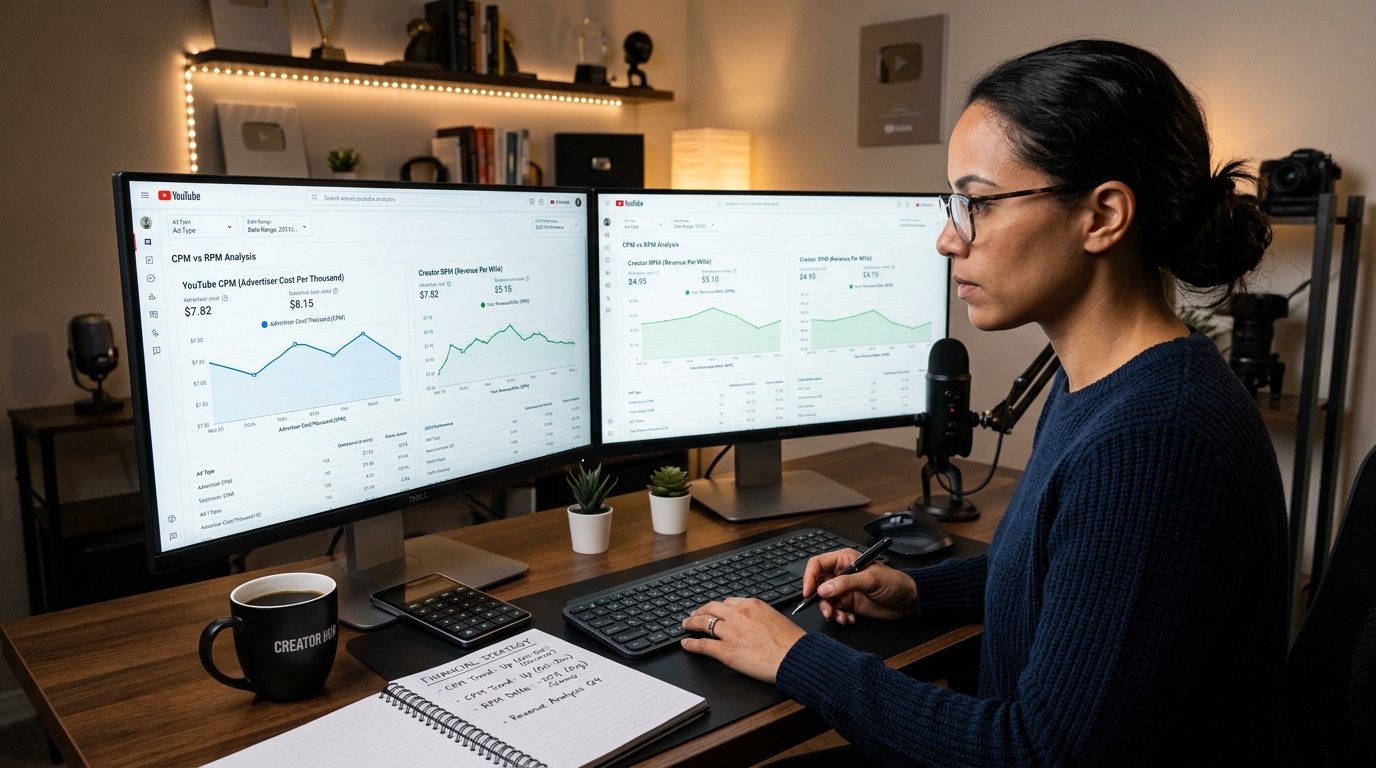
YouTube CPM and RPM are both revenue metrics found in your YouTube Studio Analytics, but they measure two completely different sides of the commercial transaction.
CPM (Cost Per Mille) represents the total gross price advertisers pay for every 1,000 commercial ad impressions served on your content. It illustrates the raw market value of your audience from the advertiser's perspective before YouTube takes its 45% platform cut.
RPM (Revenue Per Mille) represents your actual creator earnings per 1,000 total video views after YouTube's revenue share has been deducted. Crucially, RPM spreads your net creator revenue across all views, while also incorporating revenue from YouTube Premium, Channel Memberships, Super Chat, and Super Stickers.
If you are trying to calculate what your YouTube channel is actually earning, confusing these two numbers can lead to wildly inaccurate financial expectations. A $20 CPM, for instance, does not mean you will deposit $20 into your bank account for every 1,000 views. To calculate your channel's real earnings across any view volume, test your metrics with our free YouTube Revenue Calculator.
When you are planning your channel income, setting monthly targets, or projecting future cash flow, RPM is the metric that matters. CPM is useful for analyzing advertiser interest in your audience, but RPM reflects your real-world paycheck. If you are aiming for your first monetization milestone, read our guide on how to make your first $100 on YouTube.
Why Is My YouTube RPM Lower Than My CPM?
One of the most frequent surprises for newly monetized creators inside YouTube Studio is discovering a high CPM paired with a dramatically lower RPM. For example, your analytics might display an impressive $20 CPM, yet your channel RPM sits at just $5 or $6.
The reason is straightforward: your CPM is calculated exclusively from monetized ad impressions, while RPM is calculated across every single video view your channel receives.
Not every person who clicks and watches your video is served an advertisement. In fact, on many channels, 30% to 60% of total views generate zero ad impressions due to several standard factors:
- • Ad Inventory Availability: Advertisers bid for specific placements. If no advertiser has purchased inventory matching a viewer's demographic, device, and location at that exact second, no ad is served.
- • Ad-Blockers and Browser Privacy: Viewers watching on desktop browsers with ad-blocking extensions or privacy-focused mobile apps do not see ad impressions, yet they count toward your total views.
- • YouTube Premium Viewers: Premium subscribers never see commercial ads. Instead, YouTube compensates the creator via a proportional share of that user's subscription fee, which is added directly to your RPM rather than CPM.
- • Viewer Frequency Capping: YouTube's user experience algorithms intentionally prevent ad fatigue by skipping ads if a viewer recently watched several consecutive ads on other videos.
- • YouTube's 45% Revenue Split: On all long-form Watch Page ad revenue, YouTube automatically retains 45%, leaving the creator with 55% of the gross advertiser spend.
The Step-by-Step Math: How a $20 CPM Becomes a $5.50 RPM
Let's trace what happens when a long-form video accumulates 100,000 views with a $20 CPM:
The CPM accurately reflected that advertisers paid $20 per 1,000 commercial impressions. But because only half the viewers received an ad, and YouTube retained its 45% platform fee, the net take-home pay across all 100,000 views equaled $5.50 per thousand views.
Why Are YouTube Shorts Earnings So Much Lower Than Long-Form?
Creators frequently publish Shorts that generate millions of views, only to earn a fraction of what a modest long-form video produces.
The root cause is structural: YouTube Shorts and long-form videos operate under completely different monetization architectures.
On long-form content, ads are inserted directly onto your specific video playback. Advertisers place bids on your content, and you receive 55% of that direct ad spend.
In contrast, YouTube Shorts viewers scroll continuously through the vertical Shorts Feed, where ads are served between videos rather than on individual clips. YouTube pools all Shorts Feed advertising revenue into a centralized Creator Pool, deducts music licensing fees, and then distributes the remaining funds based on each creator's proportional share of total eligible Shorts views in that territory.
Because millions of Shorts views compete for this shared pool, the resulting RPM for Shorts typically ranges between $0.04 and $0.15 per 1,000 views. One million Shorts views commonly produces $60 to $120 in ad revenue, whereas one million long-form views in a commercial niche can easily generate $5,000 to $15,000. For an in-depth breakdown of this disparity, read our comprehensive study on how much YouTube pays for 1 million views: long-form vs Shorts.
The 6 Key Factors That Determine Your YouTube CPM and RPM
Your channel's earning rates are never governed by your topic in isolation. Two creators producing tutorials on the exact same software can experience drastically different earnings based on six fundamental variables:
Advertisers pay substantially higher rates to reach consumers with strong purchasing power. Audiences in Tier 1 countries (United States, United Kingdom, Canada, Australia, Germany) command CPMs of $15 to $45, whereas viewers in developing markets often yield CPMs below $2.50.
Videos watched by individuals researching an expensive purchase (such as B2B CRM software, mortgages, or camera equipment) attract high-bidding advertisers competing aggressively for clicks. Broad entertainment, gaming compilations, and memes attract lower-paying brand awareness ads.
The ratio of total views that actually trigger an advertisement. Channels whose audiences watch primarily on connected smart TVs or mobile devices often see higher monetized playback rates than channels with heavy desktop tech audiences using ad-blockers.
Advertising budgets surge dramatically in the fourth quarter (October through December) due to holiday shopping, Black Friday, and corporate year-end budget exhaustion. In January (Q1), advertisers reset budgets, causing CPMs across the entire platform to drop 20% to 50% overnight.
Long-form content that exceeds eight minutes allows creators to place manual mid-roll ads, creating two to four monetized playback opportunities within a single viewer session. Shorts remain tied to the lower Creator Pool revenue model.
Because RPM aggregates all revenue streams, channels with active Channel Memberships, Super Chat live streams, and Super Thanks badges will boast a significantly higher RPM than channels relying purely on AdSense. Review fan funding rules in our guide on YouTube Super Chat and Super Stickers.
Why Is My RPM Different From Another Creator in the Same Niche?
Sharing a niche with another creator does not mean your channel will share their revenue numbers.
Consider two creators who both produce video tutorials on "Graphic Design Software":
Focuses on enterprise Figma design systems for corporate agencies. 70% of viewers reside in the United States and Canada, aged 25 to 45. Advertisers bid aggressively on enterprise SaaS tools.
Result: $14.50 RPMFocuses on free open-source photo editing for beginner hobbyists. 80% of viewers reside in developing international regions, aged 13 to 22, with high desktop ad-block usage.
Result: $2.80 RPMBoth creators make graphic design tutorials, but the advertiser value of their audiences is vastly different.
That is why obsessing over another creator's reported $12 RPM is an unhelpful distraction. The only actionable benchmark is your own channel's historical performance across content clusters. If your software review videos consistently produce an $8 RPM while your general opinion vlogs yield $1.80, your analytics are telling you exactly what content to prioritize next. Verify niche categorization with our YouTube Category Checker.
Does Video Length Increase YouTube RPM? The 8-Minute Mid-Roll Rule
Longer videos can generate significantly higher earnings, but video length alone does not automatically increase your RPM.
On YouTube videos that reach or exceed 8 minutes in length, creators gain the ability to insert mid-roll ads manually. Instead of relying solely on pre-roll and post-roll ads, an 8-minute or 12-minute video can deliver two or three ad breaks, dramatically increasing total ad impressions per view.
However, stretching content creates a dangerous double-edged sword:
An 8-minute video that viewers abandon after 90 seconds will earn far less than a punchy 5-minute video that keeps 70% of viewers engaged until the final frame. Premature viewer drop-offs signal poor satisfaction to the algorithm, suppressing overall impressions and total views.
Never pad a 4-minute topic with fluff simply to hit the 8-minute mark. Make the video as long as the subject genuinely demands, and place mid-roll ads only where natural topical breaks occur. For proven tactics to keep viewers watching longer, read our guide on how to increase YouTube watch time.
Why Did My YouTube RPM Drop? (Troubleshooting Checklist)
A sudden drop in your RPM does not necessarily mean your channel is failing or that YouTube is penalizing your content. In most cases, an RPM dip occurs because the composition of your views changed.
Run through this diagnostic checklist inside YouTube Studio whenever your RPM declines:
Never make rash adjustments to your publishing schedule based on a single day's RPM fluctuation. Compare monthly trends, isolate audience shifts, and let data guide your decisions.
YouTube CPM and RPM Benchmarks by Niche (2026 Industry Data)
While individual creator rates fluctuate based on audience demographics, industry data reveals distinct baseline ranges across major YouTube content categories:
| Content Category | Advertiser CPM Range | Creator Net RPM Range | Payout per 100k Views | Primary Value Driver |
|---|---|---|---|---|
| Personal Finance & Investing | $25.00 – $65.00 | $12.00 – $28.00 | $1,200 – $2,800 | Banking, credit cards, brokerage bids |
| B2B SaaS & Digital Marketing | $20.00 – $50.00 | $9.00 – $22.00 | $900 – $2,200 | Enterprise software customer acquisition |
| Real Estate & Mortgages | $18.00 – $42.00 | $8.00 – $18.00 | $800 – $1,800 | High transactional loan values |
| Tech & Consumer Electronics | $10.00 – $24.00 | $4.50 – $11.00 | $450 – $1,100 | Smartphone, laptop, camera launches |
| Health, Fitness & Nutrition | $7.00 – $16.00 | $3.50 – $7.50 | $350 – $750 | Supplements, gym equipment, diet apps |
| Automotive & DIY Mechanics | $6.50 – $15.00 | $3.00 – $6.80 | $300 – $680 | Car insurance, auto parts, tool brands |
| Food Recipes & Cooking | $5.00 – $12.00 | $2.20 – $5.20 | $220 – $520 | Kitchen appliances, grocery delivery |
| Travel & Outdoor Lifestyle | $4.50 – $11.00 | $2.00 – $4.80 | $200 – $480 | Airlines, hotel booking, luggage brands |
| Gaming & Live Streaming | $2.50 – $7.00 | $1.20 – $3.20 | $120 – $320 | Broad younger demographic, gaming gear |
| Entertainment, Comedy & Memes | $1.80 – $5.00 | $0.80 – $2.20 | $80 – $220 | High view volume, broad brand awareness |
Notice the massive spread: 100,000 views on a Personal Finance channel can generate $2,000+, while the same 100,000 views on a gaming clip generates $150. Discover how to identify high-RPM tags and titles with our YouTube Video SEO Checker.
How to Legally Maximize Your Channel RPM (Actionable Playbook)
You cannot force advertisers to pay higher CPM bids, but you can intentionally configure your content strategy to capture the highest possible net RPM:
- • 1. Target Commercial Buyer Keywords: Shift from broad informational topics toward videos targeting commercial buying decisions (e.g. "Best budget microphone for podcasting" vs "how sound works"). High-intent viewers attract high-bidding advertisers.
- • 2. Optimize Video Structure for 8+ Minutes: Where topics warrant in-depth exploration, produce videos that exceed 8 minutes and insert manual mid-rolls at natural narrative pauses. Avoid auto-placement, which can disrupt critical sentences.
- • 3. Cultivate Tier 1 Geographic Distribution: Tailor your content, references, and examples to resonate with viewers in the US, UK, Canada, and Australia to drive up your average audience purchasing power.
- • 4. Activate Fan Funding Revenue Streams: Launch Channel Memberships, conduct regular live streams with Super Chat, and activate Super Thanks to layer non-ad income directly on top of your base RPM.
- • 5. Layer High-Yield Affiliate Marketing: Don't rely solely on AdSense. Recommending high-converting tools can double or triple your effective earnings per 1,000 views. Learn the full strategy in our YouTube affiliate marketing guide.
Frequently Asked Questions About YouTube CPM and RPM
Which Is Better, CPM or RPM?
Neither metric is intrinsically better because they serve different purposes. RPM is far more useful for creators judging actual channel profitability, because it reflects your net revenue per 1,000 views after YouTube's revenue share and incorporates non-ad revenue. CPM is valuable for understanding advertiser competition and market demand for your audience demographic, but it does not represent your take-home pay.
Is RPM Calculated Per 1,000 Views?
Yes. RPM stands for Revenue Per Mille (mille is Latin for thousand). It calculates how much total revenue you earn per 1,000 video views. This includes ad revenue, YouTube Premium subscription splits, Channel Memberships, Super Chat, and Super Stickers. If your channel maintains a $6 RPM, generating 100,000 total views corresponds to approximately $600 in net earnings.
How Much Is CPM Per 1,000 Views?
CPM measures the gross advertiser cost per 1,000 commercial ad impressions, not per 1,000 total video views. A $10 CPM indicates that advertisers spend $10 for every 1,000 ad playbacks before YouTube retains its 45% platform fee. Because not every view triggers an ad, your net revenue per 1,000 views (RPM) will typically be 40% to 70% lower than your CPM.
Is a $10 CPM Considered Good on YouTube?
A $10 CPM is solid across general lifestyle, tech reviews, and fitness content. However, whether a CPM is "good" depends entirely on your niche and viewer geography. In personal finance, real estate, or B2B software, a $10 CPM would be considered low (where rates regularly surpass $30). In broad gaming or meme entertainment, a $10 CPM would be exceptionally high. Always evaluate your CPM alongside your net RPM.
Can You Track RPM Before Joining the YouTube Partner Program?
No. YouTube Studio does not display CPM or RPM metrics until your channel is approved for the YouTube Partner Program. Before YPP acceptance, your official AdSense RPM is $0.00. However, unmonetized channels can still generate revenue immediately through affiliate marketing, brand integrations, and digital products. Check whether your channel meets monetization requirements using our free YouTube Monetization Checker.
Final Takeaway: Stop Chasing CPM, Start Building High-RPM Audiences
Understanding the distinction between CPM and RPM transforms how you evaluate your channel's business model.
High CPM is an indicator of market interest, but high RPM is the result of strategic content positioning: targeting viewers with commercial intent, maintaining high audience retention, structuring videos for thoughtful mid-roll delivery, and layering fan funding and affiliate models.
Focus on building authentic viewer trust in high-value niches, monitor your RPM trends over time, and let data drive your channel growth.