
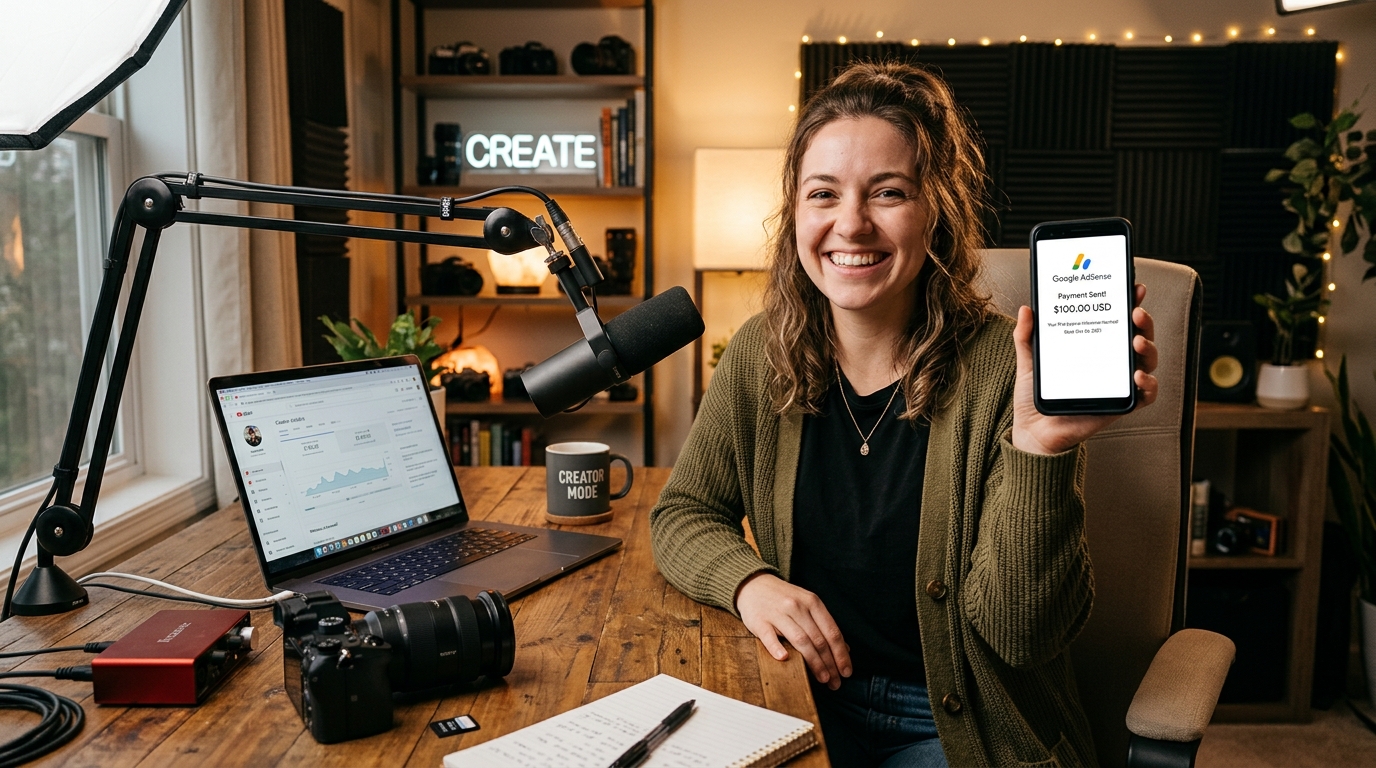
Making your first $100 on YouTube represents a psychological turning point for any creator. It shifts YouTube from an unpaid creative hobby into a validated digital business with demonstrable commercial viability.
However, most beginners get stuck because they believe the only way to earn on YouTube is through Google AdSense. They wait months or years trying to cross the YouTube Partner Program eligibility thresholds (1,000 subscribers and 4,000 watch hours), believing that revenue begins only after YouTube puts ads on their videos.
The reality is completely different. Building a valuable audience and earning YouTube ad revenue are two entirely separate concepts. In this guide, we break down exactly how many views you need to earn $100 from AdSense, how RPM determines your timeline, and the five realistic monetization strategies that allow small channels to reach their first $100 long before AdSense qualification.
How Many YouTube Views Do You Need to Make $100?
There is no universal, fixed number of YouTube views that equals $100. If your channel is already monetized under the YouTube Partner Program, the single metric that matters most is your RPM (Revenue Per Mille) — how much money your channel actually earns per 1,000 total views.
The mathematical formula to calculate the views required to reach any revenue goal is straightforward:
Because RPM varies drastically across genres, viewer locations, and demographics, your required view count can fluctuate by tens of thousands of views:
- • At a $2.00 RPM: You need approximately 50,000 views ($100 ÷ 2 × 1,000). Common in gaming, casual vlogging, and broad entertainment.
- • At a $5.00 RPM: You need approximately 20,000 views ($100 ÷ 5 × 1,000). Common in tech reviews, productivity, lifestyle, and fitness.
- • At a $10.00 RPM: You need approximately 10,000 views ($100 ÷ 10 × 1,000). Typical for personal finance, B2B software, real estate, and digital marketing.
Views Required to Earn $100 Across Channel RPM Levels
| Channel RPM Tier | Views Needed for $100 | Typical Content Niches | Viewer Geographic Profile |
|---|---|---|---|
| $1.00 RPM | 100,000 views | Gaming compilations, reaction videos, comedy sketches | Mixed / Tier 2 & 3 traffic |
| $2.00 RPM | 50,000 views | Pop culture commentary, general lifestyle, travel vlogs | Global mixed audience |
| $3.50 RPM | 28,571 views | Cooking recipes, fitness workouts, home DIY | US, UK, Canada, Australia |
| $5.00 RPM | 20,000 views | Consumer tech, gadget reviews, camera tutorials | Tier 1 purchasing power |
| $8.00 RPM | 12,500 views | E-commerce tutorials, productivity software, coding | US & Western Europe |
| $10.00 – $15.00+ RPM | 6,666 – 10,000 views | Personal finance, investing, business SaaS, mortgages | High-intent commercial buyers |
That is why copying someone else’s generic estimate — such as "YouTube pays $2 per thousand views" — can lead your channel astray. For a deep dive into the difference between advertiser pricing and creator revenue, explore our YouTube CPM vs. RPM Guide and test your own numbers with our free YouTube Revenue Calculator.
The practical move: Open YouTube Studio → Analytics → Revenue, find your true channel RPM, and work backward from $100. If one specific category of videos consistently earns $8 RPM while another earns $1.50, double down on the higher-earning topic rather than simply chasing raw view counts. And remember: numbers in YouTube Analytics are estimated; finalized earnings are deposited through your AdSense for YouTube account once you reach the $100 payment threshold.
Can You Make Your First $100 Before YouTube Monetization?
Yes, absolutely. Building a commercially valuable audience and qualifying for YouTube’s advertising revenue program are two completely different things.
You do not need a massive channel before your content can have genuine financial value. Even a brand-new channel with 300 subscribers and 500 views per video can generate $100 quickly if those viewers have a clear, focused reason for watching.
The Viewer Behind the View: Entertainment vs. Commercial Intent
Consider the mindset of the person watching your video. Someone watching a compilation of humorous video clips is consuming passive entertainment. Monetizing that viewer with a small audience is nearly impossible because they have no immediate commercial problem to solve.
In contrast, someone searching for “how to fix audio clipping in Premiere Pro” or “best budget microphone for recording podcasts” is actively researching a solution. They have an immediate problem, an active budget, and an urgent next step.
🎯 The Golden Monetization Question:
“What does my viewer already want to do immediately after watching this video?”
If your video answers that question by recommending the exact tool, template, or service they need to finish the job, you create a natural commercial transaction. That is why small creators make $100, $500, or $1,000 before ever qualifying for AdSense.
The most common mistake new creators make is trying to monetize the channel before understanding what makes the audience valuable. First identify the viewer's underlying intent; then select the revenue model that seamlessly fulfills that intent.
How to Make Your First $100 With YouTube Affiliate Marketing
Affiliate marketing is often the fastest and most realistic path to earning your first $100 on YouTube because you do not need to build, code, or inventory a product. You simply recommend an existing solution and earn a commission when a viewer makes a purchase through your link.
However, affiliate marketing only succeeds when the video naturally creates buying intent. Simply dropping an Amazon affiliate link in the description box of a generic gaming video and praying someone clicks will yield zero sales.
Build Content Around Decision-Making Queries
Instead of general uploads, create videos that directly help viewers make an impending purchasing decision:
- • Tool Selection: “Which microphone is best for home podcasts under $100?”
- • Direct Comparisons: “ConvertKit vs. Mailchimp for Beginner Creators (2026 Comparison)”
- • Real-World Teardowns & Reviews: “Is the Shure SM7dB Worth the Upgrade? 30-Day Honest Review”
- • End-to-End Starter Guides: “How to Set Up a Home Recording Studio from Scratch”
Work Backward from Commission Economics
Once you identify the product, reverse-engineer how many conversions you need to reach $100:
A video that attracts only 300 highly targeted viewers looking to choose podcast hosting software can easily generate 4 sales of a $25 commission tool, earning your first $100 in a single weekend. That small, intent-driven audience is vastly more profitable than 50,000 views on a generic meme channel.
For a comprehensive breakdown of commission structures and compliance guidelines, see our YouTube Affiliate Marketing Guide.
How to Make $100 on YouTube Without AdSense
If you do not want your financial growth tethered to advertising algorithms, stop measuring the value of your channel solely by view counts. The superior question is: What can this specific audience pay for?
The monetization model must align directly with what your channel is naturally good at delivering:
-
💼
High-Skill Tutorials $\rightarrow$ Freelance Services & Consulting: A video teaching how to configure complex automation workflows can prompt a viewer to hire you for a 1-hour $100 consultation to implement it for them. You need exactly one client.
-
🎨
Creative & Design Channels $\rightarrow$ Digital Templates: Selling a $15 Notion operating system, Photoshop mockup bundle, or video editing LUT pack requires just 7 sales to cross the $100 mark.
-
🏋️
Fitness & Lifestyle $\rightarrow$ Structured Custom Plans: Selling a downloadable 8-week mobility or training program for $25 requires only 4 buyers from your community.
Do not attempt to execute all of these models simultaneously. For your first $100, select one revenue engine that matches the demand of the audience you already attract, and build 2–3 dedicated videos that support that exact offer.
Can Small YouTubers Make $100 From Sponsorships?
Yes. Brands do not buy subscriber numbers; they buy targeted access to an audience that trusts you.
A channel with 2,000 subscribers that exclusively reviews B2B productivity software can easily secure a $100 to $250 sponsorship from an emerging SaaS startup. That brand would gladly pay to reach 500 dedicated business owners rather than spending $2,000 on a 100,000-subscriber gaming channel where viewers have zero business software purchasing intent.
How to Pitch Brands as a Small Creator
When reaching out to potential brand partners, avoid the common mistake of saying: “I have 1,500 subscribers, will you sponsor me?” Instead, structure your pitch around audience alignment:
1. Audience Demographic: “My channel reaches over 4,000 active remote freelancers and independent creators monthly who are actively upgrading their audio setups.”
2. Content Natural Fit: “In my upcoming video covering budget studio audio interfaces, your product solves the exact connectivity hurdle my viewers face.”
3. Clear Scope of Deliverables: “I am offering a dedicated 45-second mid-roll integration with a pinned comment link for a flat rate of $100.”
Be realistic about the deliverables. A brand requesting a dedicated 15-minute review video with permanent commercial licensing rights is asking for far more than a $100 integration. Define the exact scope (e.g., a 45-second shoutout) before agreeing to the rate.
What Can You Sell on YouTube to Make Your First $100?
The easiest product to sell is never the one you can create the fastest. It is the product your audience is already repeatedly asking for in your comments section.
If people watch your videos to learn a skill or overcome a hurdle, analyze what tool, asset, or shortcut would help them finish the task in half the time:
Motion graphics project files, title cards, color grading LUTs, sound design packs.
Boilerplate code templates, cheat sheets, API configuration scripts, developer workflows.
Notion dashboards, spreadsheet financial trackers, client proposal contracts.
Lightroom presets, guitar chord guides, drum sample packs, vocal preset chains.
Simple Pricing Math for Your First $100
You do not need an expensive $100 course. Breaking $100 down into accessible price points makes the sales target easily achievable:
| Offer Price | Sales Required | Total Revenue | Required Views (at 2% Conversion) |
|---|---|---|---|
| $10.00 Offer | 10 sales | $100.00 | ~500 targeted views |
| $25.00 Offer | 4 sales | $100.00 | ~200 targeted views |
| $50.00 Offer | 2 sales | $100.00 | ~100 targeted views |
| $100.00 Service | 1 sale | $100.00 | ~50–100 targeted views |
Do not build a 100-page eBook or an 8-module video course. Build the smallest possible digital asset that solves one genuine pain point, host it on a free checkout platform like Gumroad or Payhip, and place the link in your video description and pinned comment.
Can You Make Your First $100 From YouTube Fan Funding?
Yes, but fan funding functions very differently from advertising. You are not receiving programmatic revenue simply because someone watched an impression; viewers must make an active, emotional decision to support you financially.
Under YouTube’s early Partner Program tiers, creators with 500 subscribers and 3,000 watch hours unlock fan-funding modules:
- • Super Thanks: One-time tips given directly on recorded on-demand videos and Shorts.
- • Super Chat & Super Stickers: Highlighted paid messages sent during live streams and Premieres. For full payout math, see our YouTube Super Chat and Super Stickers Guide.
- • Channel Memberships: Recurring monthly payments for custom loyalty badges and community perks.
Community Connection vs. Search Traffic
Fan funding follows relational connection, not informational search. A channel where viewers arrive from Google Search, watch a 3-minute tutorial to fix a dishwasher, and leave will receive zero fan funding because the relationship is purely transactional.
Conversely, a creator who hosts interactive weekly live streams, does live channel critiques, answers community questions, or provides direct emotional reassurance builds intense audience loyalty. Five dedicated community members sending $20 Super Chats during a single live audit stream will cross the $100 threshold in under an hour.
Which Way Is Easiest for Your First $100? The Decision Framework
The easiest way to make your first $100 does not depend on your channel subscriber count. It depends entirely on what your audience is already doing because of your content.
Use this clear diagnostic roadmap to select your ideal path:
The winning model is always the one with the shortest distance between your content and the viewer’s logical next step.
Frequently Asked Questions About Making $100 on YouTube
Here are practical answers to common questions about earning benchmarks, view calculations, and payout rules for emerging channels.
Q1: How to Earn $100 From YouTube?
To make your first $100 on YouTube, match your revenue model to your current audience behavior: if you have monetized views, calculate your view targets from your RPM; if viewers watch for product reviews, insert affiliate links; if viewers ask for help, offer a $50 consulting call or freelance service; and if you reach a targeted commercial demographic, pitch small sponsorships. You do not have to wait for large subscriber milestones to start testing monetization.
Q2: Is 2,000 Views in 1 Day Good?
Yes — if 2,000 views in 24 hours is significantly above your channel's standard baseline, it represents strong momentum. However, inspect YouTube Studio Analytics to examine traffic sources and average percentage viewed. If the views stem from Search, Browse, or Suggested feeds and maintain high retention, you have identified a winning topic. If it was an external spike that immediately dropped, do not assume it will repeat without intentional topic optimization.
Q3: How Many Views Do I Need on YouTube to Make $100?
For monetized AdSense revenue, calculate it directly from your RPM using the formula: ($100 ÷ RPM) × 1,000. At a $2 RPM, you need approximately 50,000 views; at a $5 RPM, you need 20,000 views; and at a $10 RPM, you need 10,000 views. Never rely on generic third-party averages; inspect your channel's specific RPM in YouTube Studio.
Q4: Does YouTube Pay $1 Per 1,000 Views?
No. There is no flat $1 per 1,000 views rate on YouTube. If your channel's RPM is $1.00, you will earn approximately $1 per 1,000 views, but other creators in finance or technology frequently earn $10 to $20+ per 1,000 views. Do not confuse CPM (what advertisers pay before YouTube takes its 45% cut) with RPM (what you actually take home across all video views).
Q5: How Long Does It Typically Take to Make Your First $100 on YouTube?
If relying strictly on AdSense views, it typically takes emerging creators 6 to 18 months to reach 1,000 subscribers, 4,000 watch hours, and accumulate the first $100 payment threshold. However, creators who integrate high-intent affiliate links or sell a $50 consulting service frequently reach their first $100 within their first 30 to 60 days of publishing.
Q6: Can YouTube Shorts Help Me Reach $100 Faster?
Shorts are phenomenal for rapid channel discovery, but their direct ad RPM is extremely low (typically $0.05 to $0.15 per 1,000 views). Earning $100 from Shorts ads alone requires 1 to 2 million views. However, using Shorts to direct viewers to an affiliate recommendation or your long-form videos is a highly effective growth accelerator. For tactical advice, read our guide on how to use Shorts to grow long-form channels.